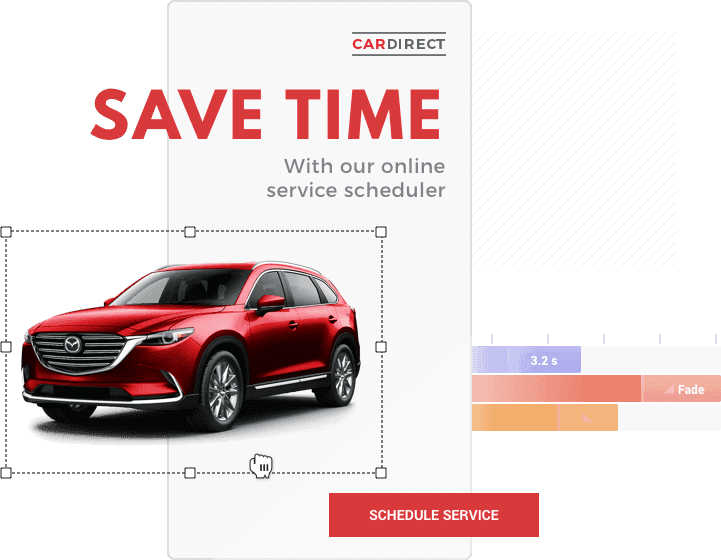
Display banner advertising sounds like a term nobody needs explained, since you've seen thousands of banners and probably clicked a few by accident. Yet most definitions still describe a channel where people bought the space, chose the audience, and made the ad. In 2026, software does more of all three: Google is moving Display into Demand Gen and testing ads that Gemini writes inside AI Mode, and 83% of ad executives say their company has already used AI in the creative process, according to the IAB. That's reason enough to set the record straight. Display banner advertising places visual ads, from static images to animated HTML5 units, on the websites and apps people read, watch, and scroll through. Display is the channel, and the banner is its best-known ad unit. What's changed is who does the work: the buying, the targeting, and increasingly the design run through AI, while the banner itself stays the part a brand controls.
Key takeaways
Display banner advertising places image, animated, or HTML5 ads on websites and apps; banners are display's best-known format.
US display ad revenue reached $81.6 billion in 2025, up 9.8% on 2024, according to the IAB/PwC Internet Advertising Revenue Report.
Seven parties run a display sale: the advertiser, DSP, ad exchange, ad network, SSP, publisher, and ad server.
83% of ad executives say their company has used AI to make ads, yet only 45% of Gen Z and Millennial consumers feel positive about them.
A display impression counts as viewable when at least 50% of the ad is on screen for one continuous second.
Google Ads accepts uploaded image ads up to 150 KB and HTML5 ads up to 600 KB, and animated GIFs up to 30 seconds.
How does display banner advertising work?
A display banner reaches a page in three steps, and software now handles most of each one: an advertiser sets up a campaign, a bidding algorithm buys an impression (one showing of an ad on a screen) on a publisher's page, and an ad server delivers the banner and counts what happens next. That automated buying is called programmatic advertising, and US programmatic ad revenue reached $162.4 billion in 2025, up 20.5%, according to the IAB/PwC Internet Advertising Revenue Report.
Google's own display product is changing shape as well. Google is moving its Display campaigns into Demand Gen, with a migration tool rolling out in phases from June 2026 and the move expected to finish by 2027, while the Google Display Network keeps serving those ads. The ad formats and standard sizes themselves are covered in our guide to banner basics, so this article doesn't repeat them.
[Image: simple flow diagram, advertiser to DSP to ad exchange to SSP to publisher page, with the ad server delivering the banner]
Display advertising ecosystem: who does what in each sale
Seven parties take part in a typical display sale, and most of them are software making decisions while the page loads. They split into a buy side, a sell side, and the marketplaces in between:
Player | Side of the sale | What it does |
Advertiser | Buy side | Sets the budget, the goal, and the creative, then hands most of the buying to software |
DSP (demand-side platform) | Buy side | Bids for the advertiser, impression by impression, across many publishers and within the budget and goal the advertiser set |
Ad exchange | Middle | Runs the auction that matches one impression to the best qualifying bid, usually in real time |
Ad network | Middle | Bundles ad space from many publishers into one buy, the way the Google Display Network does |
SSP (supply-side platform) | Sell side | Offers a publisher's ad space to exchanges and buyers on the publisher's terms |
Publisher | Sell side | Owns the website or app and sells the space around its content |
Ad server | Both sides | Stores the banners, sends the winning one to the page, and counts impressions and clicks |
The ad server is where a banner file meets a real page. When someone opens a news article on a site that sells display space, the page asks the ad server for an ad, and the ad server returns the winning banner, then records the impression and any click that follows. Publishers and advertisers can each run their own ad server, so both sides of the sale keep a count.
How do you buy display advertising?
You can buy display advertising through an ad network, through a DSP that bids programmatically, or directly from a publisher. The three routes differ in how much control you get and how much setup they ask for:
Ad network. The Google Display Network is the best-known example: Google Ads Help describes it, as of 2026, as more than 2 million websites, videos, and apps that reach over 90% of internet users worldwide, citing Comscore. You set the targeting and the budget, and Google places the banners.
Programmatic buying through a DSP. A DSP bids on single impressions across many exchanges through real-time bidding (RTB), an auction for one ad impression that runs while the page loads. The highest bid that matches the targeting wins, and the banner appears a moment later.
Direct deals. You agree on the placement, dates, and price with one publisher, which suits niche sites whose readers match your customers closely.
Display is commonly priced by CPM (cost per mille, the price of 1,000 impressions). The rate depends on the audience, the placement, and the season, which makes cost a topic of its own.
Why use display banner ads?
Display banner ads reach people while they browse, show a brand or an offer in one visual, and report every impression, click, and conversion, including conversions from people who saw the ad and never clicked. US advertisers spent $81.6 billion on display formats (banner, rich media, sponsorship, and native) in 2025, up 9.8% and equal to 27.7% of all digital ad revenue, according to the same IAB/PwC report. Advertisers put that money behind display for its reach, its visual format, its measurement, the value of an ad nobody clicked, and a role that AI search doesn't take over:
Reach beyond search. Search ads wait for a query, while display ads appear on the news sites, blogs, and apps people already spend time on.
A visual format. One image or animation carries the product, the offer, and the logo before anyone reads a line of copy.
Measurement. Ad platforms count impressions, clicks, and conversions per banner, so you can compare sizes, messages, and placements against each other.
Value without a click. A view-through conversion is a sale or sign-up from someone who saw the ad, didn't click, and converted later; for Display campaigns, Google Ads gives that credit to the last impression.
A place outside the answer box. As search turns into a conversation with AI assistants, display stays the place where people meet a brand they didn't think to ask about.
Who can advertisers target with display ads?
Google splits display targeting into two families, people and content, and each layer you add narrows the audience. Every targeting choice trades reach for precision.
People targeting uses audience segments: affinity segments (long-term interests and habits), in-market segments (people actively researching something to buy), custom segments built from keywords, URLs, and apps, detailed demographics, life events such as moving house, and your data segments built from your own site visitors and customer lists. Location targeting adds countries, regions, cities, or a radius around an address.
Content targeting places the banner by what's on the page. Contextual targeting puts ads next to content about a related topic through keywords or topics you choose, while placement targeting names a specific website, page, app, or video.
Retargeting with display ads: reaching past site visitors
Retargeting shows display ads to people who already visited your site or app, and in Google Ads it runs through your data segments, the feature Google used to call remarketing. A visit adds the person to a list, and when they later browse sites and apps on the Display Network, your banner can appear in front of them again.
Retargeting is the display tactic closest to a sale, because the banner reaches someone who already knows the brand. That person may have viewed a product or left a full cart, so the banner can name the exact item or offer instead of introducing the company from scratch.
Customer Match works from a different list: contact details, such as email addresses, that customers shared with you. Both approaches need a frequency limit, because a banner that follows someone around for three weeks stops reading as a reminder and starts reading as surveillance.
When should your business use display banner ads?
Display banner ads work best when the goal is to be seen by the right people before, during, or after they consider buying, and each goal calls for its own targeting and its own measure of success:
Business goal | What the ad does | Targeting to use | What to measure |
Product or service launch | Introduces the new offer to a wide, relevant audience | Affinity and in-market segments | Reach, impressions, view-through conversions |
Brand awareness in a new market | Builds familiarity where the brand is unknown | Location targeting plus affinity segments | Reach, frequency, viewable impressions |
Consideration | Keeps the product in view while people compare options | In-market and custom segments, contextual targeting | Site visits, engaged sessions |
Retargeting visitors and cart abandoners | Brings back people who left without buying | Your data segments | Conversions, return visits |
Lead generation | Promotes a sign-up, demo, or download | Custom segments, contextual targeting, placements | Form submissions, cost per lead |
Local reach | Tells nearby people about a store, clinic, or event | Location targeting by city or radius | Store visits, calls, direction requests |
Seasonal offers | Pushes a time-limited sale to likely buyers | In-market segments plus your data segments | Conversions and revenue during the offer window |
Most display campaigns combine two or three business goals. A launch, for example, pairs a wide awareness push with a retargeting set for everyone who visited the launch page, and each goal keeps its own budget and its own report, so a weak result in one doesn't hide inside the average of the other.
What is an example of display advertising?
Example 1: awareness. A regional coffee roaster enters a new city with 300×250 and 728×90 banners that show the bag, the roast, and the logo. Affinity segments for cooking fans plus location targeting for the new city put the banners on recipe sites and local news, and the roaster tracks reach and viewable impressions for the first eight weeks, before any click-through rate tells it much.
Example 2: retargeting. An online furniture store shows banners with the exact sofa a visitor viewed to everyone in its your data segment from the last 30 days. The banner carries the product photo, the price, and a free-delivery line, and the store measures conversions and the share of returning visitors who finish checkout.
Example 3: launch. A project management app launches a new feature and needs the same message in five sizes across the Display Network, from a 320×50 mobile banner to a 300×600 half-page ad. In-market segments for business software carry the reach, and view-through conversions show how many trial sign-ups came from people who saw a banner without clicking it.
Display banner advertising vs. search advertising
Display ads reach people who aren't searching yet, and search ads reach people who already are. The two channels also differ in format, placement, and the mindset of the person who sees the ad:
Feature | Display banner ads | Search ads |
Format | Images, animation, or HTML5 in fixed or responsive sizes | Text headlines, descriptions, and links |
Where the ad appears | Websites, apps, and videos across a network | Search results pages |
Who sees it | People who match an audience or a content topic | People who typed a related query |
Main goal | Awareness, consideration, retargeting | Capturing demand that already exists |
User intent at that moment | Reading, watching, or browsing something else | Looking for an answer or a product |
Search ads also run out of room: they reach only as many people as type the query, so a product few people search for yet has little search demand to capture. Display has no such ceiling, which is why launches lean on it.
Choose search when people already look for what you sell, and display when they need to learn it exists or need a reason to come back. Running both works as a loop: display builds demand and brings visitors back, and search catches them when they come looking.
Are banner ads still effective?
Banner ads still work as a mature, steady channel: US display revenue grew 9.8% to $81.6 billion in 2025, according to the IAB/PwC report, while social media grew 32.6% to $117.7 billion and digital video grew 25.4% to $78 billion. Display advertising isn't dead; it grows more slowly than the newer formats, and its $81.6 billion still tops digital video's $78 billion.
Clicks are the weak spot. Click-through rates on display run low, and no neutral, standards-body benchmark tells you what a good rate is, so judge a display campaign on reach, viewable impressions, and view-through conversions as well as clicks.
A fair test measures a display campaign against its own goal. A retargeting set should show conversions within weeks, while an awareness push in a new market shows up first in reach and viewable impressions, and later in branded searches and direct visits to the site.
Challenges of display ads: viewability, ad blocking, banner blindness
Viewability. An impression counts as viewable only when at least 50% of the ad's pixels are on screen for at least one continuous second, under the Media Rating Council (MRC) guideline; ads of 242,500 pixels or more need 30%. Google's Active View measures display ads against that standard, so ask for viewable impressions in your reports and favor placements close to the content people read.
Ad blocking. About 1.1 billion people used an ad blocker in Q4 2025, around 30% of internet users, according to the 2026 ad-blocking report by eyeo, a company that sells ad-filtering technology. Blocked banners never load, so they shrink the audience a campaign can reach, and display works better as one part of your reach than as all of it.
Banner blindness. People tend to ignore page elements that look like ads, a pattern the Nielsen Norman Group confirmed again in a 2018 eyetracking study. Our look at why readers tune banners out covers it in depth; the short version is to rotate formats and creatives so the same banner doesn't stay in the same spot for months.
How display banner ads get made for ad networks
A display campaign needs one creative per placement size, each under the ad network's file limits, before the network accepts it. Google Ads accepts uploaded image ads in GIF, JPG, or PNG up to 150 KB and HTML5 ads up to 600 KB, and animated GIFs can run for 30 seconds at most. A production-ready set covers sizes, file weight, and variations:
Sizes per placement. Common sizes include the 300×250 rectangle, the 728×90 leaderboard, the 300×600 half-page ad, the 336×280 large rectangle, the 160×600 wide skyscraper, and the 320×50 mobile banner. The IAB's 2017 ad portfolio adds flexible units defined by aspect ratio.
File weight. A static image suits a single offer, and HTML5 earns its extra kilobytes when motion explains the product or reveals the offer in steps.
Variations. One message in six sizes means six files to build, check, and export, and a test of two headlines doubles that.
AI can now build much of a production-ready banner set. Google's responsive display ads assemble an ad from your images, headlines, and logos to suit each ad space, and at Google Marketing Live in May 2026 Google announced new Asset Studio features that connect design tools to its latest Gemini models to turn brand guidelines into creative faster. Both trade some control over the final layout for speed and coverage, and audiences are cooler on the result than the industry assumes.
In an IAB study published in January 2026, 45% of Gen Z and Millennial consumers felt positive about AI-generated ads while 82% of executives believed they did, and 20% of those consumers called brands that use AI manipulative, twice the executives' 10%. The IAB's AI disclosure framework, released the same month, asks for a label only when AI materially affects an ad's authenticity, identity, or representation, so AI use alone doesn't call for one, while a synthetic avatar that simulates a person does.
Automation handles the volume, and someone still has to decide what the brand looks like at every size. Good banner ads keep one message, a visible brand, and a clear call to action, including in the 320×50 strip where there's room for little else. Bannersnack is built for that designer-controlled version: you build HTML5 display ads that export as ready-to-upload files for Google Ads and other supported ad platforms, and Smart Resize adapts one design to the sizes a network asks for.
[Image: one banner design shown in four standard sizes side by side]
Pick one use case from the table above, choose the targeting that matches it, and prepare the banners in every size the network asks for, inside its file limits. Give the campaign enough time to show reach and viewable impressions before you read anything into the click-through rate. When the set is ready to build, the next step is one click away: Start designing.
P.S.
Next time a banner loads on a news site, think about its commute. The publisher's SSP offers the impression to an exchange, a few DSPs bid on it, and the winner's ad server sends the file while both sides count the impression, all in the time the page takes to load. Software handles every step of that trip except the rectangle itself, unless you let Gemini make that too, so it might as well be a good one.