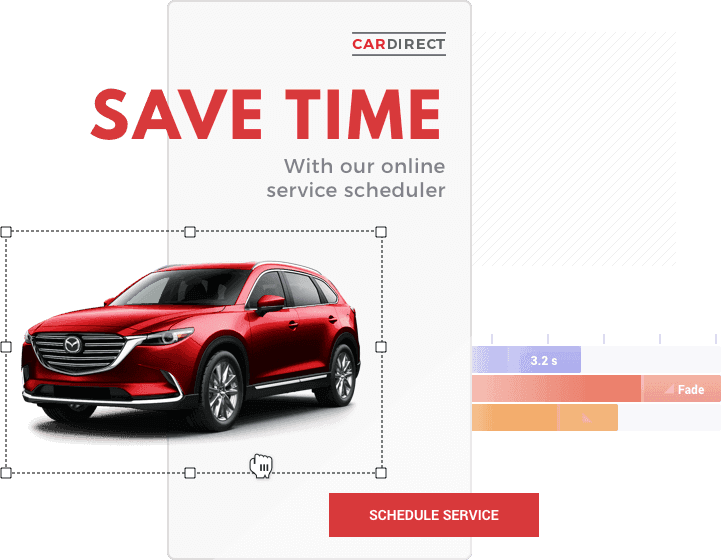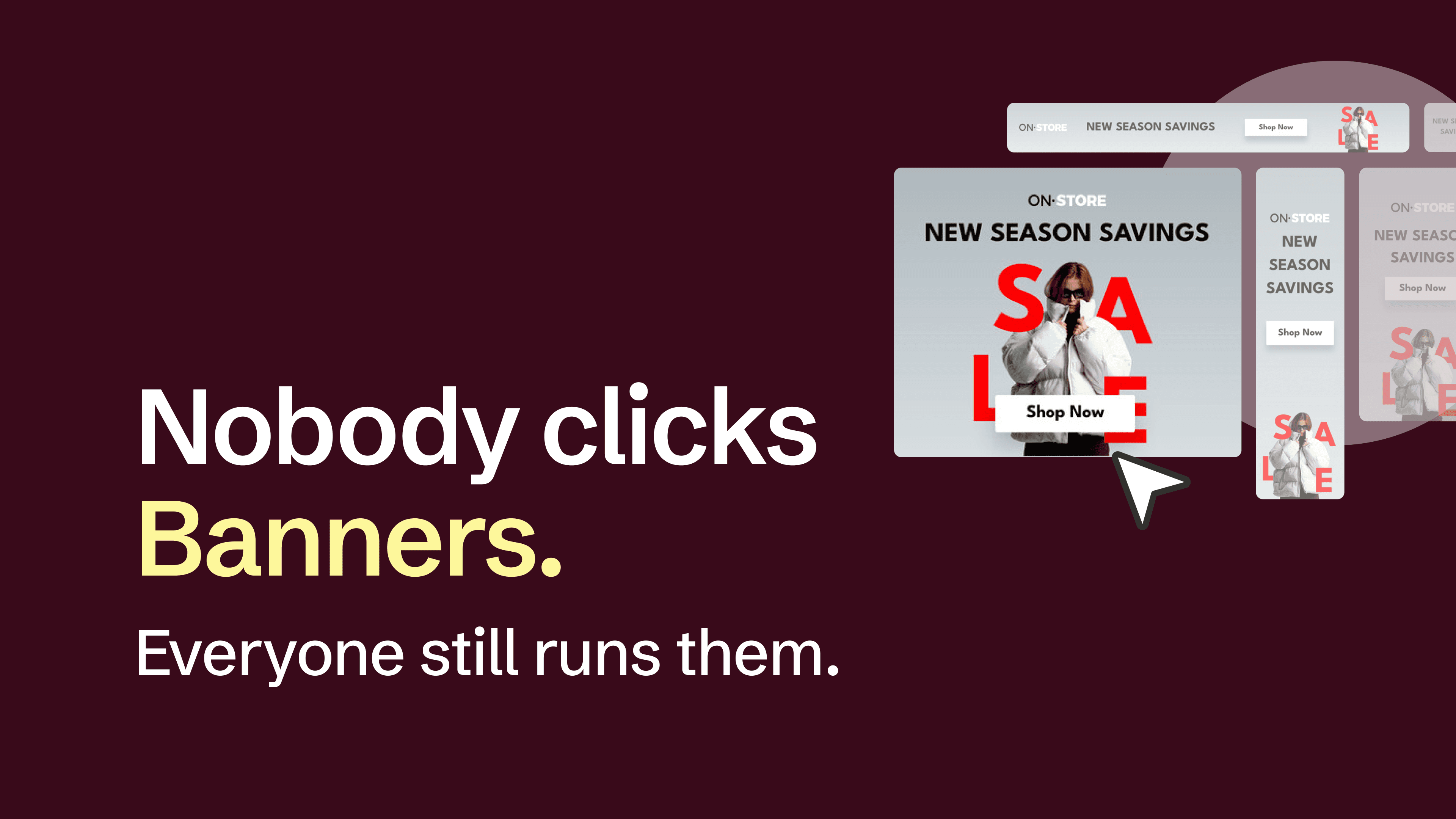
A banner ad is an image-based ad that appears on a web page and links to the advertiser's site, usually shown as a small rectangle along the top, side, or inside the content of the page you're already reading. It's the format behind nearly every ad you scroll past on a news site, blog, or app: a static or animated image promoting a product or offer, sitting next to the content you came for. If you've picked up two conflicting stories about banner ads, that they're a cheap, easy way to reach new customers, and that nobody clicks them anymore, you're not entirely wrong on either count. This guide settles both: what a banner ad is, how it gets placed in front of a specific visitor in the time it takes a page to load, whether banner ads are still worth a small business's budget today, and how you'd go about creating one.
Key takeaways
A banner ad is a rectangular, image-based ad embedded in a web page that links to the advertiser's site.
Real-time bidding, a per-impression auction across a demand-side platform, a supply-side platform, and an ad exchange, decides which banner you see.
Every banner ad is a display ad, but not every display ad is a banner: video and native ads count as display advertising too.
Banner ads are priced under three models: CPM (per 1,000 impressions), CPC (per click), or CPA (per completed action); CPM is the most common.
Average banner click-through rate on the open programmatic web runs about 0.05% to 0.1% in 2026, far below the often-cited, unverified 44% figure from the first 1994 banner.
Banner ads earn their budget on awareness and retargeting; search ads better capture existing buying intent, and social or video suit precise targeting.
What are banner ads?
A banner ad is a rectangular or square, image-based advertisement embedded in a web page or app, designed to drive traffic or awareness by linking to the advertiser's website.
Banner ads are the oldest form of digital display advertising, sold and placed by the sites that host them (publishers) in exchange for a fee. That model, selling ad space to fund free content, is still how most publishers keep sites free for readers today, which is a large part of why the format never went away. A banner can be a single static image or an animated sequence, but the format itself hasn't changed much since October 27, 1994, when AT&T ran the first banner ad on HotWired, Wired magazine's website. The core idea has stayed the same: a defined space carved out of a page, filled with a creative that links elsewhere when a visitor clicks it.
Banner ads are one format within the larger category of display advertising, the broad group of visual ads (image, video, and rich media) shown across websites and apps. A banner is display advertising's original, most standardized shape: a fixed-size rectangle in a predictable spot, as opposed to, say, a video ad that plays before content or a native ad styled to match a page's own layout.
The Interactive Advertising Bureau (IAB), the industry body that sets the technical standards most publishers and ad platforms follow, is the reason a "medium rectangle" or "leaderboard" means the same size everywhere online. That standardization matters more than it sounds like it should, and it's worth understanding before you get to sizes further down.

How do banner ads work?
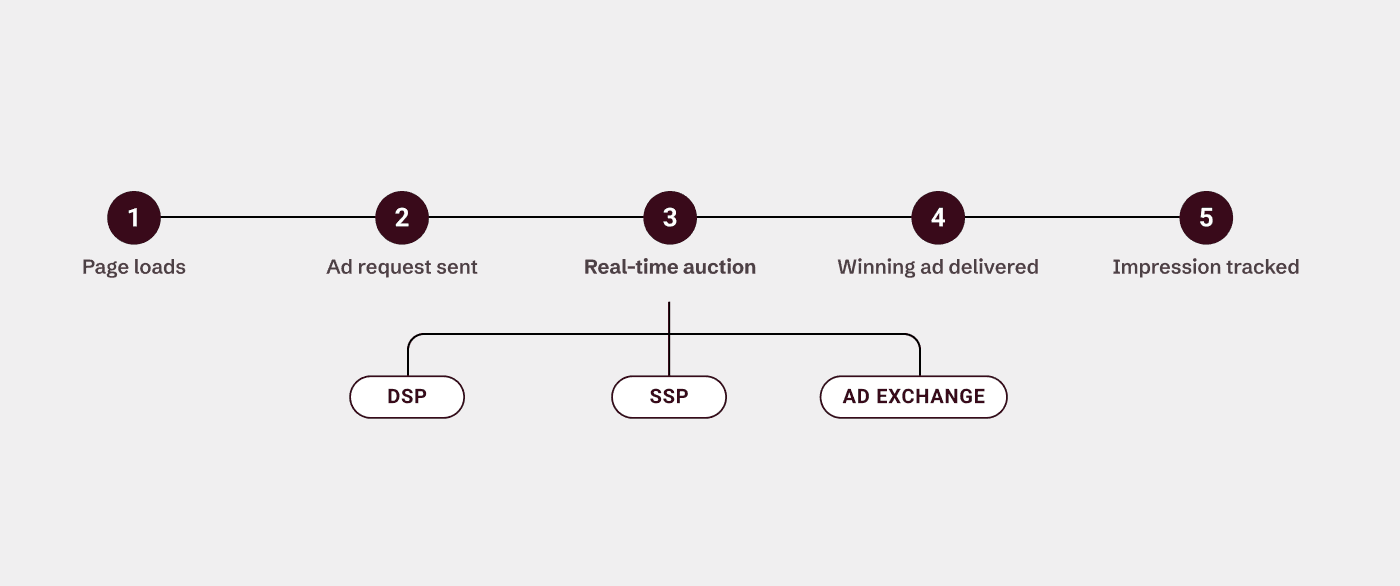
Serving a banner ad runs through an automated auction that finishes in the time it takes a web page to load: a publisher puts ad space up for bid, advertisers bid for it through software, and the winning creative gets delivered and tracked, all in well under a second.
When you open a page carrying ad space, that visit triggers an ad request before the page finishes loading. The publisher's site sends details about that specific slot (its size, its position, and some information about the visitor) out to the open market.
What happens next is an auction: multiple advertisers' systems assess that one opportunity and place a bid, the highest qualifying bid wins, and the winning banner is delivered to your browser and rendered in that slot. Once it's shown, tracking code records the impression and, if you click it, sends you to the advertiser's landing page while logging that click against the campaign.
What is programmatic advertising?
This automated buying and selling of ad space is called programmatic advertising. Advertisers manage their bids through a demand-side platform (DSP), software built for buying ad space at scale across many sites at once.
Publishers manage their available inventory through the mirror-image tool, a supply-side platform (SSP), which puts that space up for bid and accepts the highest offer. The ad exchange is the marketplace between them: it matches a specific ad request with the advertisers willing to pay for it, in real time.
How does real-time bidding (RTB) work?
The auction that decides which ad you see is called real-time bidding, or RTB, a per-impression auction that runs as a page loads. Every time an impression becomes available, the ad exchange treats it as a fresh, one-off auction.
Advertisers set rules in their DSP (who to target, and the most they're willing to pay), and the DSP bids automatically on any impression that matches those rules. This repeats for every ad slot on every page load, across billions of auctions a day.
How do small businesses run banner ads?
None of this is something a small business needs to build or manage directly. In practice, running a banner ad means designing a creative, uploading it to an ad network (a service, such as the Google Display Network, that gathers ad space from many publishers and places your ad across them), and setting a budget, an audience, and a goal.
The auction, the bidding, and the delivery described above happen automatically once your campaign is live. What you control is the creative, the targeting, and how much you're willing to pay per impression, click, or action, covered under pricing below. Retargeting campaigns, which show your ad specifically to people who already visited your site, use the same mechanism, just aimed at a narrower, warmer audience.
What types of banner ads are there?
Banner ads fall into two broad groups: standard formats that most campaigns start with, and advanced formats that trade simplicity for more engagement.
Standard formats: static and animated banners
A static banner is a single, fixed image: no motion, no interaction, just one creative shown for the ad's full run. It's the simplest format to design and the lightest to load, which makes it a reasonable starting point for a first campaign.
An animated banner adds movement, usually as a GIF or an HTML5 file built from multiple frames or timed transitions. Animation gives you more room to fit a headline, an image, and a call to action into a small space by cycling through them, though it also means a heavier file, and on some networks, a stricter size limit than a static banner would face.
Rich media and interactive banner formats
Rich media banners go further, building in video, audio, or interactive elements such as a form or a product carousel a visitor can use without leaving the page. An expandable banner starts at a standard size and grows, usually on hover or click, into a larger unit. An interstitial banner takes over the full screen between two pages loading, most common in apps and mobile sites. A responsive display ad automatically adjusts its own creative to fit whichever ad slot it lands in, which is one reason format and sizing overlap as much as they do.
Retargeting banners (also called remarketing banners) aren't a distinct visual format so much as a targeting method: the same static or animated creative, shown specifically to people who already visited your site or viewed a product.
Older formats like the pop-up and pop-under still exist but are worth naming mainly as a caution. Both are widely considered intrusive and dated, several browsers block them by default, and neither reflects how a modern banner is meant to behave alongside a page's content rather than over it.
What are the standard banner ad sizes?
The IAB sets the standard banner sizes most sites and ad networks support, and a handful of them cover the large majority of placements you'll run.
The most common sizes are:
the medium rectangle (300x250),
the leaderboard (728x90),
the wide skyscraper (160x600),
the half page (300x600),
the mobile leaderboard (320x50).
If you're building only one size to start, the medium rectangle is the safer choice: it's the most-cited best-performing size across the industry, in part because it blends into a page's content rather than only running along an edge.
Ad networks also cap file weight, not just dimensions. Google Ads allows 150 KB for an image ad and 600 KB for an HTML5 one, so a creative has to clear both limits at once.
Bannersnack's size guide has the full chart if you want every standard placement, and a separate post breaks out the Google-specific dimensions that Google Ads accepts.

How much do banner ads cost?
Banner ads are priced under one of three models, CPM, CPC, or CPA, and which one fits depends on what you're trying to achieve.
Model | You pay for | Best when |
|---|---|---|
CPM (cost per mille) | Every 1,000 times your ad is shown | Your goal is awareness or reach, not an immediate click |
CPC (cost per click) | Each click on your ad | Your goal is driving traffic to a specific page |
CPA (cost per action) | Each completed action, such as a sign-up or a sale | Your goal is a measurable conversion, and you'll only pay for results |
CPM is the most common pricing model for banner campaigns, largely because banners have historically been sold as an awareness format first. Whichever model you choose, the impression (one instance of your ad being shown to a viewer) is still the basic unit everything else gets measured against. It's what CPM is priced on, and it's the denominator behind your click-through rate, covered next.
For a small business, the pricing model matters as much as the price itself. A campaign built on CPM can run at almost any budget, from a single afternoon's test to a multi-month push, because you're buying impressions in bulk rather than committing to a fixed placement fee the way a print ad or a sponsorship would work. That's also what makes banner ads measurable in a way older ad formats weren't: every impression, click, and completed action gets logged and tied back to what you paid for it, so you can see exactly what a given budget bought.
Are banner ads still effective?
Banner ads still work, but not the way display advertising worked in 1994. Expect a low click-through rate by design, and treat banners as an awareness and retargeting tool rather than a direct-response channel built to close a sale on the first click.
What is a realistic banner ad click-through rate?
Click-through rate, or CTR, is the share of people who click your ad out of everyone who saw it. As of 2026, average banner CTR on the open programmatic web runs roughly 0.05% to 0.1%, low enough that it surprises marketers used to email or search benchmarks.
Tightly targeted campaigns on a managed ad network run higher, often between 0.1% and 0.4% depending on the industry. A low CTR isn't a sign a campaign failed: awareness formats are built to be seen, not necessarily clicked, the same way a billboard succeeds without anyone pulling over.
Myth: banner ads once pulled a 44% click-through rate. That figure, credited to AT&T's 1994 "You Will" banner on HotWired, has been repeated for thirty years with no primary source and no surviving campaign data behind it. Executives who sold the early Yahoo banners have put their click-through rates closer to 15%, still striking by today's standards but nowhere near the myth. Either way, that free-for-all novelty era ended decades ago; modern banner CTR on the open programmatic web runs 0.05% to 0.1%. |
What is banner blindness?
Banner blindness is the learned habit of viewers ignoring anything on a page that looks like an ad, developed after decades of seeing the same rectangular shapes in the same few spots. It's a genuine limitation of the format, and it's part of why some visitors also install ad blockers rather than deal with banners at all.
Bannersnack goes deeper into why viewers tune out banners and what designers do about it. Admitting this upfront matters more than pretending banners convert like search ads. They don't, and expecting them to is the fastest way to call a working campaign a failure.
Are banner ads still relevant in the AI era?
Banner ads were running on AI before the term became a buzzword: the real-time bidding auction described above is a machine-learning system deciding which impression to buy, in milliseconds, with no person involved. What's new is the AI on the audience side. As more people get answers from AI chat tools and AI-generated search summaries instead of clicking through to a publisher's page, organic search traffic to those pages has come under real pressure, though not at the scale the loudest numbers suggest: US organic search traffic was down about 2.5% year over year going into 2026, with median publisher traffic down closer to 10%.
Fewer page visits mean fewer chances to show a banner on them. That's a distribution problem for publishers, not proof the format stopped working: most people still spend their time on ordinary web pages and inside apps, where banner inventory runs regardless of how they got there.
When do banner ads work best, and when to use another format?
Banner ads earn their budget on three jobs: awareness, retargeting, and building brand recognition over time. They're weakest as a cold-traffic, direct-response tool aimed at buyers who've never heard of you. The most common mistakes are a call to action that's easy to miss, a size mismatched to where it's placed, and a landing page that doesn't match what the ad promised. When the goal is capturing people already searching for what you sell, a search ad usually outperforms a banner. When the goal is precise audience targeting on social platforms, or storytelling that needs more than a few seconds, social ads and video suit the job better. Banners still do something those formats don't as well: put your brand in front of a broad audience passively, at a comparatively low cost per impression.
Banner ads vs. display advertising: what's the difference?
Display advertising is the umbrella category for all visual ads on websites and apps (image, video, and rich media); a banner ad is one specific, image-based format within that category.
Every banner ad is a display ad, but not every display ad is a banner. A video ad that autoplays in an app, or a native ad styled to match a publisher's own article layout, both count as display advertising without fitting the rectangular, standardized shape of a banner. If someone asks you to run a "display banner ad," in practice they mean a banner: the two terms describe the same rectangular, image-first format from slightly different angles.
The confusion is understandable, since banners were the first display format most people ever saw, and for a long stretch of the internet's history the two words meant exactly the same thing.
How do you create a banner ad?
Building a banner ad comes down to a short sequence: pick a size and a goal, design the creative around one message, export the file (or a full set of sizes), and run it through an ad network.
Start with the size a specific placement calls for, or a small common-size set if you don't know exactly where it'll run yet. Export the file, or a resized set for several placements, and upload it to your ad network of choice.
Bannersnack is built to design and resize banner sets without code: it scales one layout across 50-plus standard ad sizes and exports to HTML5, MP4, GIF, PNG and JPG. Its guide to exporting to HTML5 walks through that step in more detail.
What makes an effective banner ad?
A few things consistently separate banners that work well from ones that don't.
One message, since a banner has too little space and too few seconds to carry more than one idea.
A visible call to action, not an afterthought squeezed into a corner.
A size matched to its placement, rather than whatever creative you already had on hand.
Brand-consistent visuals, so the ad doesn't look like it belongs to someone else.
A landing page that matches the ad's promise, since a mismatch there is a common reason a decent click-through rate still doesn't convert.
A banner ad is a measurable, image-based ad format built for awareness and retargeting. Its low click-through rate is by design, and its size, its auction, and its pricing are standardized enough that a small business can run one without managing any of the machinery behind it.
The path from an idea to a live banner is short: pick a size, design around one message, and put it in front of the right audience through an ad network or a tool like Bannersnack. If you want to see what that looks like in practice, 10 campaigns analyzed for designers is the natural next stop.
P.S. If you're reading this line, you just out-clicked the average banner ad. At a 0.05% to 0.1% click-through rate, maybe one person in a thousand ever clicks one. Make it count.