Super Bowl ads win attention. Banner ads win conversions. From Budweiser nostalgia to the Claude vs. ChatGPT AI feud, the real story starts after the game—when display ads turn hype into measurable revenue.
Key takeaways
Only 1% of Super Bowl viewers make immediate purchases, but 43% express interest and need follow-up touchpoints to convert. From Super Bowl LX alone, that represents 51.6 million people who required retargeting to act.
Global display advertising generates $235 billion annually, 3.9 times larger than all U.S. television advertising combined, with roughly 190,000 designers working on banner production every week versus approximately 10,100 people employed in Super Bowl-style commercial production.
Each post-Super Bowl retargeting campaign requires 12 to 18 unique banner files covering Google Display Network IAB sizes, social platform variants, and animated formats in HTML5, GIF, and MP4.
Manual resizing across 12+ banner sizes takes 3 to 5 hours per campaign. At 20 campaigns monthly, that compounds to 60 to 100 hours of mechanical work. Purpose-built resize tools reduce this to 1.5 to 2.5 hours per campaign.
Banner advertising produces direct, trackable attribution: average CTR of 0.46%, e-commerce conversion rates averaging 2.35%, ROAS of $2.80 to $4.20 per dollar invested, and A/B test results within 48 to 72 hours.
Bad Bunny’s grass got 12.3M views. Then 190,000 designers started making the banners that actually convert.
Every February, advertising gets its mainstream moment. Super Bowl LX was no exception. NBC charged up to $10 million for 30 seconds of airtime. 120 million people watched 54 commercials squeezed between pregame, four quarters, and a halftime show that broke the internet.
On the field, Sam Darnold wrote the kind of story sports journalists dream about. A quarterback who’d been traded, benched, and publicly labeled one of the worst starters in the NFL led the Seattle Seahawks to a 24-13 win over the Patriots. At 28, after bouncing between five teams, he became a Super Bowl champion. BBC Sport called it “the ultimate redemption story”. The kind of second act that reminds you why 120 million people still watch a single football game when everything else in media is splintering into niches.
At halftime, Bad Bunny brought 500 performers onto the field wearing 40-pound grass costumes representing Puerto Rican sugarcane fields. Within 24 hours, the performance had 12.3 million TikTok views.
So you had a redemption story on the field, a halftime performance that went viral overnight, and $550 million in earned media from the ads sandwiched between them.
Then Monday morning arrived. X and LinkedIn filled up with hot takes and carousels about “What Super Bowl LX Taught Us About Brand Storytelling.” What none of those posts mentioned, only 1% of Super Bowl viewers make immediate purchases. But 43% express interest and need follow-up touchpoints to convert. That’s 51.6 million people out of 120 million who thought “that was cool” and then went about their evening.
Those 51.6 million don’t convert from spectacle. They convert from banner ads, the ones nobody writes LinkedIn posts about.
While the hot takes were still being drafted, designers across advertising agencies and in-house marketing departments had already started the actual post-game work: building banner ads, resizing creative into 12 different aspect ratios, exporting HTML5 files under 150KB, and meeting Tuesday deadlines for retargeting campaigns that would take the emotional residue of a $10 million spot and attach a discount code, a deadline, and a tracking pixel to it.
This is what happens after the show ends, and it’s the story of a $235 billion industry that nobody celebrates.
📺 We made a short film about this gap between spectacle and daily ad production!
The ads that won, the ads that bombed, and the AI feud in between
USA TODAY’s Ad Meter ranked all 54 Super Bowl LX commercials using real-time consumer voting . The winners leaned hard on formula that works:
Rank | Ad | Score | What Worked |
1 | Budweiser “American Icons” 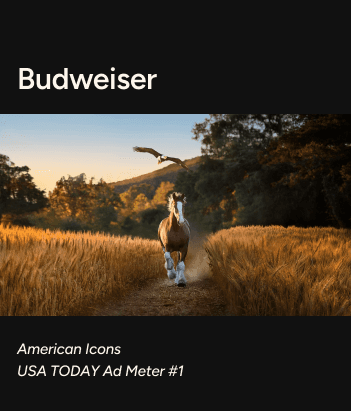 | 4.00/5 | Clydesdales and patriotic imagery. Nostalgia at its most effective. |
2 | Lay’s “The Lay’s Challenge” 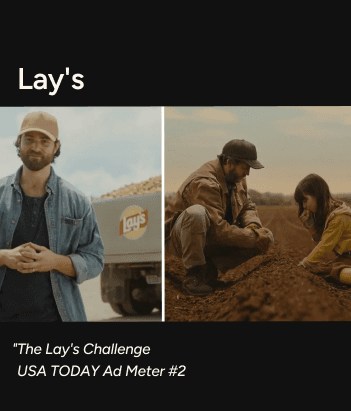 | 3.80/5 | Contest format that generated 7.1× median engagement. |
3 | Pepsi “Cola Bea 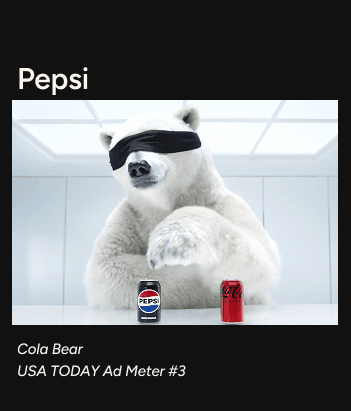 | 3.50/5 | A bear choosing Pepsi over Coke. Absurdist, shareable. 38,000 social mentions. |
4 | Dunkin’ “Good Will Dunkin'” 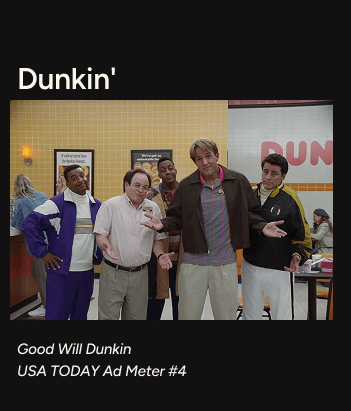 | 3.48/5 | Aniston, LeBlanc, Affleck reunion. 90s nostalgia with 5× engagement lift. |
5 | Michelob Ultra “ULTRA Instructor”  | 3.47/5 | Kurt Russell coaching athletes with an Olympics tie-in. |
Nostalgia, humor, clear product connection. The playbook hasn’t changed much. What did change was the volume of AI advertisers trying to elbow into the conversation. Nearly a quarter of all Super Bowl LX ads featured AI themes, and the execution gap between them was enormous.
Google Gemini’s “New Home” earned an A-grade by showing a family using AI to visualize home renovations. Practical, clear, and you understood the value before the logo appeared.
Then Anthropic did something nobody expected from an AI safety company. They bought two 30-second Super Bowl spots. Created by agency Mother, the first aired pregame around 6:15 p.m. ET and the second ran in the first break after kickoff. Both showed helpful AI interactions interrupted by intrusive product pitches we’ve all learned to tune out (a dating app, a fitness subscription). The tagline: “Ads are coming to AI. But not to Claude.”
The jab at OpenAI’s publicly discussed ChatGPT ad integration plans was unmistakable. Sam Altman responded on X calling the spots “deceptive” (15,000 retweets). #ClaudeSuperBowl and #AIFree trended simultaneously. Claude scored 2.45/5 on Ad Meter. On Reddit’s r/technology, “Claude owning ChatGPT ads, based!” pulled 20+ upvotes alongside execution criticism (“bold but skit meh”). Forbes noted the spots worked better as a stakeholder signal than a consumer message, which might have been the point all along.
At the opposite end: Ai.com and Coinbase both earned F-grades for failing to explain what their products actually do. The lesson within a single commercial break was stark. Showing specific value beats abstract positioning every time.
What real viewers said vs. what analysts said
The professional rankings tell one story. Reddit and X tell a more honest one.
Most loved:
Ad/Content | Platform Reaction | Notable Quote |
Bad Bunny’s grass | r/SuperBowl viral thread | “The grass was more memorable than any commercial” (47K upvotes) |
Budweiser Clydesdales | r/television | “Loved the Clydesdale and bird. Pure nostalgia!” (darkpaladin, 20+ upvotes) |
T-Mobile Backstreet Boys | X clips went viral | B-grade consensus, 2.5× engagement. Musical number energy. |
Pringles (Sabrina Carpenter) | r/television, X shares | “Stupid funny with mustaches and the fly” (10+ upvotes) |
Most hated:
Ad | Complaint | Engagement |
Liquid IV | “Ruined ‘Against All Odds’ with a toilet song” | 80+ upvotes r/SuperBowl60 |
Gambling/AI saturation | Viral poem: “Gambling AI Gambling AI” | 18 upvotes r/television |
Temu (aired 5 times) | “Cringey billionaire slogan on repeat” | 29 upvotes r/CommercialsIHate |
#SuperBowlAds hit 500K+ posts on X. Roughly 30% of threads called it “worst batch in years,” rescued by nostalgia standouts and the Claude drama (r/television, r/CommercialsIHate, r/SuperBowl, February 8-9, 2026).
Even the best-received ads generated cultural moments, not sales. Which brings us back to those 51.6 million interested viewers, and the infrastructure required to actually convert them.
The uncomfortable math: What advertising actually is
Ask someone to picture “advertising” and they’ll describe creative directors in modernist offices brainstorming culture-defining campaigns, celebrity endorsements, and Cannes Lions trophies. The glamorous 0.1% that makes headlines and fuels X discourse for 48 hours.
The reality is a different industry entirely:
Category | Annual Spend | Share of Total |
Global display advertising | $235 billion | 42% of digital spend |
U.S. display advertising | $98 billion | Growing 54% since 2020 |
All U.S. TV advertising | ~$60 billion | 11% of total (declining) |
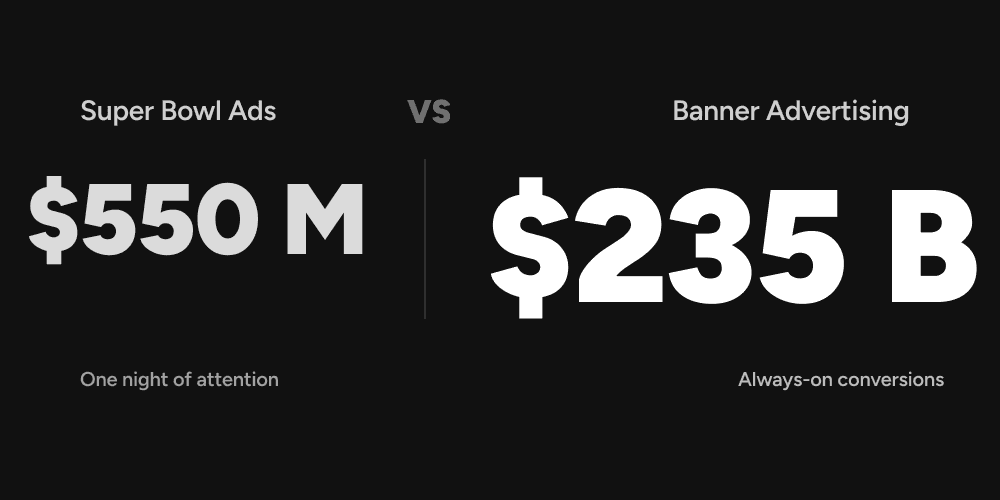
Super Bowl LX (all advertisers) | $550 million | Once per year |
Display advertising is 3.9× larger than all television advertising combined. Every week, banner ads drive $1.88 billion in U.S. spend without generating a single Reddit thread, TikTok reaction, or Ad Meter ranking. The workforce behind this output is proportionally massive: approximately 870,000 people work in banner and display advertising across the U.S., compared to roughly 10,100 in the Super Bowl-style commercial production that gets all the cultural attention.
Here’s where it gets personal for most businesses. There are 6.1 million employer firms in the U.S., 99.9% with fewer than 500 employees. About 50 companies can afford a Super Bowl spot. Over 5.4 million businesses rely on banner advertising to compete. A regional retailer with $2M in annual revenue can’t produce a Clydesdale commercial or put 500 performers in grass costumes. But it can run targeted display campaigns for $500-2,000 monthly and know exactly what each dollar returned.
That’s the gap between the advertising we celebrate and the advertising that actually runs the economy.
The performance trigger: Where banners pick up what spectacle left behind
Jeff Gagne, SVP at Havas Play, framed it well: “Brands that see the biggest returns treat the Super Bowl as a three- to four-week-long ecosystem with strategic convergence points before, during and after the game”. Adam Schwartz, SVP at Horizon Media, was more direct: it’s a “performance trigger.” The commercials build awareness and the sales happen later .
The mechanics of “later” explain why banner infrastructure matters at scale. Those 51.6 million interested viewers get tagged through website visits, social engagement, and search behavior in the days following the game. Over the next weeks, retargeting campaigns serve them banner ads carrying what a Super Bowl spot structurally cannot: a specific discount, a deadline, a “Shop Now” button, and a tracking pixel connecting each click to revenue.
The emotional connection was built during the game. The banner gives it a price point and a Tuesday expiration date.
The measurement difference is where CFOs start paying attention. Nobody will ever calculate exactly how many purchases came from Pepsi’s cola bear or from the Claude/OpenAI feud driving signups. Those signals are directional, survey-based, and correlational at best. Banner attribution works differently. Average CTR sits at 0.46%, with e-commerce conversion rates averaging 2.35% and ROAS ranging from $2.80-$4.20 per dollar invested. A/B test results reach statistical significance in 48-72 hours, and revenue is tracked to the individual click.
The retargeting banner carrying Pepsi’s cola bear with a 20% discount generates attribution data within 24 hours. That’s not a philosophical difference in measurement approach. It’s the difference between knowing and guessing.
Why the actual production work is harder than anyone admits
Post-Super Bowl, every major advertiser launches retargeting campaigns simultaneously. During a typical week, U.S. display advertising involves roughly $1.88 billion in spend, 420,000-480,000 active campaigns, and approximately 190,000 designers working. That weekly total is 2.6× the Super Bowl’s entire advertiser investment.
Each campaign needs a standard deliverable set. Google Display Network requires six IAB sizes (300×250, 728×90, 160×600, 300×600, 320×50, 970×250). Social platforms need variants for Facebook feeds, Instagram Stories, and LinkedIn. Animated versions require HTML5 for programmatic, GIF for social backup, MP4 for certain placements. Total per campaign: 12-18 unique banner files. Small-to-mid agencies handle 15-30 campaigns monthly, and post-Super Bowl that volume spikes as brands want retargeting creative live while cultural relevance is fresh.
Where the hours disappear
The creative challenge is real but underappreciated. Budweiser’s majestic Clydesdale becomes an unidentifiable brown blob at 320×50 pixels. Text readable at desktop resolution turns illegible on a mobile leaderboard. Pepsi’s cola bear looks charming at full size and vaguely unsettling at 160×600. You’re maintaining brand consistency with Super Bowl creative while adding urgency messaging (“20% off ends Friday”) and direct CTAs (“Shop Now”) across drastically different aspect ratios.
That creative work accounts for 30-40% of the time on a typical campaign.
Resizing eats the rest. The manual approach means duplicating the master design for each of the 12 remaining sizes, repositioning every element, adjusting text for readability, and re-exporting each file. When the client changes “20% off” to “25% off” you update all 12 files individually, then find a typo, fix it across all versions, and re-export everything again.
Time per campaign with manual methods: 3-5 hours. At 20 campaigns monthly, that’s 60-100 hours of mechanical resizing, or roughly two and a half full work weeks spent on what is the same creative in different rectangles.
A smart template approach (linked elements, intelligent resize, manual correction of the 30-40% where auto-layout breaks) brings that down to 1.5-2.5 hours per campaign. That’s 30-50 hours saved monthly, a full work week returned to actual design.
Then comes the technical layer that earns zero recognition. Google enforces 150KB file size limits strictly. HTML5 animations must stay under 30 seconds with no auto-play audio. Instagram Story safe zones cut off text in the top and bottom 250 pixels. Each platform has different format restrictions, clickTag implementations for tracking, and export specifications. Ryan Zia, SVP at Dentsu Media Sports, noted that even QR codes in ads require specific sizing, contrast ratios, and placement to scan reliably.
The AI nuance in production workflows
The same AI conversation playing out in Super Bowl commercials (Claude vs. ChatGPT, Google Gemini vs. everyone) is echoing inside banner production workflows. AI-assisted tools can now generate initial design concepts, suggest copy variations, and help adapt layouts for different sizes. That’s genuinely useful for the creative phase.
But banner ad production sits at an awkward intersection. It’s a technical discipline with platform-specific constraints that don’t forgive approximation. A file that’s 151KB instead of 150KB gets rejected by Google. An HTML5 animation at 31 seconds gets rejected. A clickTag implemented incorrectly means zero attribution data.
AI can accelerate ideation and first drafts. The production bottleneck, though, isn’t coming up with the idea. It’s the mechanical work of turning one good concept into 18 platform-compliant files while meeting spec requirements that change across Google, Meta, LinkedIn, and programmatic exchanges. That’s where purpose-built banner tools earn their place in the workflow, handling the constraints automatically so designers can focus on the creative decisions that actually affect performance, which is exactly the problem Bannersnack was built to solve.
How Bannersnack fits into this workflow
Bannersnack launched in 2008 as the original online banner maker. After sustained demand from users who needed a focused banner design workflow without unnecessary complexity, it was brought back as a standalone product dedicated to display and social advertising. It’s a tool built around the specific production bottlenecks that consume designer hours at scale, not a general-purpose creative suite.
At low volume, the production friction described above is survivable, annoying but manageable. At 15+ campaigns monthly, those 3-5 hours of mechanical resizing per campaign compound into 60-100 hours of lost capacity, and the workflow economics shift decisively.
Here’s what Bannersnack handles in the daily production grind:
HTML5 export with a visual timeline editor, so teams meet Google’s and other DSPs’ technical requirements for HTML5 banner ads without writing code.
Smart Resize for multi-size efficiency, handling approximately 60% of size adaptations correctly on the first pass and saving hours versus building each size from scratch.
Linked elements that propagate changes across all sizes. Updating “20% off” to “25% off” or swapping a product image happens once instead of twelve times, and over a month with multiple clients, those saved minutes compound into recovered days.
Brand consistency systems with asset libraries and version control, preventing the compounding errors that come from managing four brands at deadline speed.
Technical automation covering file compression, HTML5 specs, and batch export with naming conventions, so the invisible production requirements don’t occupy mental bandwidth.
Teams producing at volume with Bannersnack report creating banner sets up to 10× faster than manual methods and saving roughly 15 hours per week on production tasks. For an agency billing $150/hour, that’s $9,000 monthly in recovered capacity. For an in-house team, it’s the difference between a sustainable operation and starting to lose people.
Conclusion
The Super Bowl is over. Darnold’s improbable path from league afterthought to champion at 28 has been analyzed from every angle, Bad Bunny’s 500 grass performers are back to their regular lives, and the Claude vs. OpenAI feud has cooled. X moved on to another topic entirely.
But across the U.S. alone, 190,000 designers continue the work that turns attention into revenue. Banner campaigns referencing Super Bowl creative run across Google, Facebook, Instagram, LinkedIn, and programmatic platforms, reaching those 51.6 million people who were interested but didn’t buy that night.
These banners won’t get 12.3 million TikTok views or 47,000 Reddit upvotes, and they won’t appear in Ad Meter rankings or win Cannes Lions. What they will do is generate thousands of trackable conversions, deliver A/B test results within 72 hours, and produce the ROI data that determines whether next year’s Super Bowl investment is justified at all.
The same industry contains all of it: Super Bowl LX cost $550M for one night of cultural attention, Bad Bunny’s grass generated 12.3M viral views and genuine meme status, and banner advertising generates $235B annually in measurable, attributable conversions. All three create value. Only one converts interest into revenue for the 99.9% of businesses that can’t afford grass costumes, redemption narratives, or Super Bowl airtime.
Somewhere right now, a designer is building a banner that references Budweiser’s Clydesdales, with “25% off. Ends Friday” in a copy that works at 320×50 pixels and exports to HTML5 under 150KB. By week’s end, it will drive 143 trackable conversions. That banner won’t trend, but it pays salaries, and that’s the $235 billion infrastructure making viral grass profitable.